
Panda Express Allergen Menu 2026: All 9 Allergens
If you have a food allergy, ordering at Panda Express requires more than just picking your favorite dish. The restaurant uses shared woks, shared fryers, and shared utensils across every item on the menu — which means allergen cross-contact is possible in nearly every meal, even in items that don’t contain that allergen by recipe.
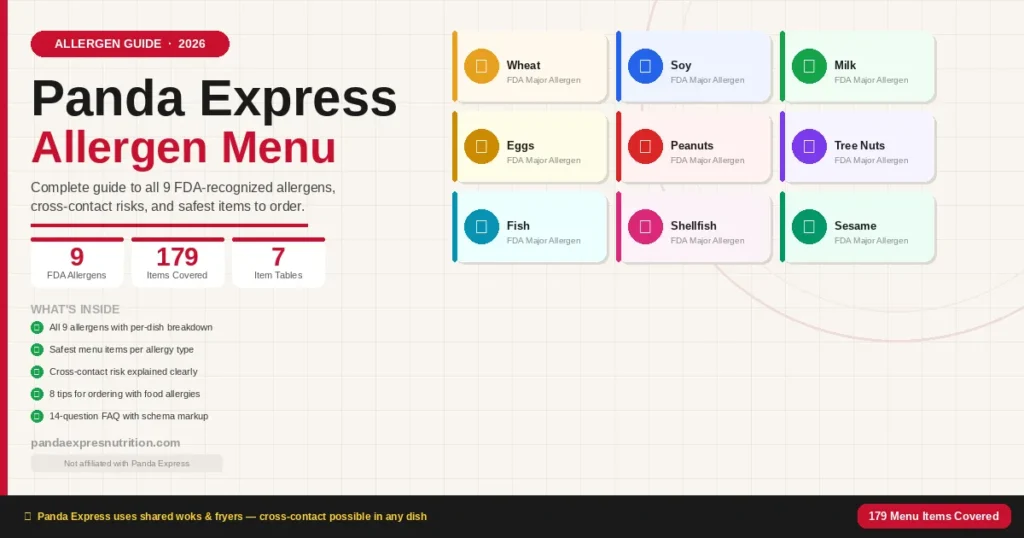
Whether you manage a wheat allergy, a soy intolerance, a peanut allergy, or a shellfish sensitivity — read this before your next visit.
What Is the Panda Express Allergen Menu?
The Panda Express allergen menu is an official guide published by Panda Restaurant Group that lists the 9 major FDA-recognized food allergens present in each menu item. It covers every entree, side, appetizer, sauce, and beverage on the menu.
The allergen guide uses a checkmark system: a checkmark (✓) next to an item confirms that allergen is intentionally present in the recipe. However, the guide does not account for cross-contact during cooking — which is a separate and significant risk in any Panda Express kitchen.
You can access the official allergen PDF at pandaexpress.com/nutritioninformation, or ask for a printed copy at any Panda Express location.
Allergens listed in the official Panda Express guide:
- 🌾 Wheat
- 🫘 Soy
- 🥛 Milk (Dairy)
- 🥚 Eggs
- 🥜 Peanuts
- 🌰 Tree Nuts
- 🐟 Fish
- 🦐 Shellfish
- 🌱 Sesame
These are the same 9 allergens required to be disclosed under the FDA Food Allergen Labeling and Consumer Protection Act (FALCPA), updated with the addition of sesame as a major allergen in 2023.
The 9 FDA Allergens at Panda Express
Here is how each allergen appears across the Panda Express menu — and which dishes are the biggest sources.
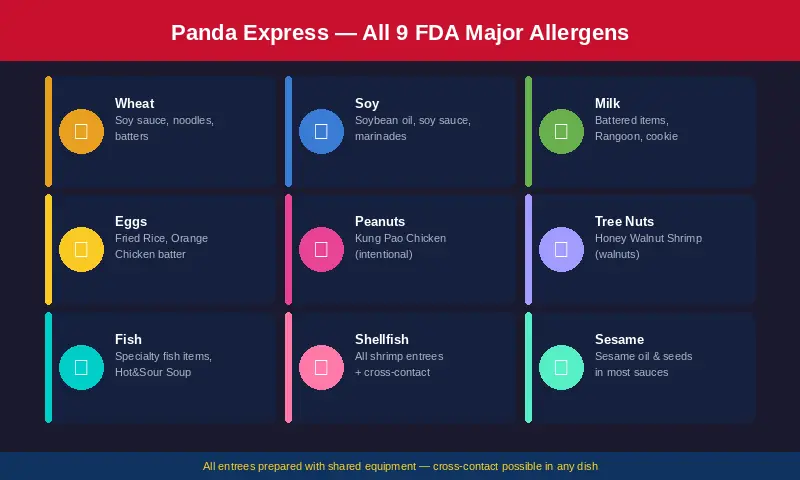
1. Wheat (Gluten)
Wheat is the most widespread allergen at Panda Express. It appears in almost every savory dish on the menu because soy sauce — a foundational ingredient in Chinese-American cooking — is made with fermented wheat. Marinades, batters, noodles, and most stir-fry sauces all contain wheat.
Dishes with the highest wheat content: Chow Mein, Fried Rice, Chow Fun, Orange Chicken, Beijing Beef, Kung Pao Chicken, and most chicken and beef entrees.
Items with no listed wheat in the recipe: White Steamed Rice, Brown Rice.
⚠️ Important: Panda Express does not certify any item as gluten-free. Plain rice avoids wheat by recipe, but shares the same kitchen environment as wheat-heavy dishes. Cross-contact with wheat is highly likely.
2. Soy
Soy is present in virtually every cooked dish at Panda Express. Soy sauce is the backbone of most marinades, wok sauces, and glazes on the menu. Panda Express primarily uses soybean oil for cooking — not peanut oil — which means soy is also present at the cooking-oil level.
Items with no listed soy: White Steamed Rice, Brown Rice, and most plain beverages.
If you have a soy allergy, only plain steamed rice and plain water-based drinks are reliably free from intentional soy ingredients. Cross-contact from shared woks remains a risk even then.
3. Milk (Dairy)
Dairy is less common in traditional Chinese cooking, but several Panda Express items use milk in breading and cream-based fillings.
Key dairy-containing dishes:
- Cream Cheese Rangoon — cream cheese is the primary filling
- Orange Chicken — contains milk in the batter
- Beijing Beef — contains milk in the crispy batter
- Crispy Shrimp — contains milk
- Chow Fun — contains milk
- Chocolate Chip Chunk Cookie — dairy-heavy
Plain steamed rice, Super Greens, Chow Mein, and most stir-fried chicken and beef entrees (except Beijing Beef) are dairy-free by recipe.
4. Eggs
Eggs are found in breading, rice dishes, and baked items at Panda Express.
Primary egg-containing dishes:
- Fried Rice — eggs are cooked directly into the dish
- Orange Chicken — eggs in the batter
- Honey Walnut Shrimp — eggs in the batter
- Hot & Sour Soup — eggs in the base
- Chocolate Chip Chunk Cookie
- Cream Cheese Rangoon — egg wash used on wrappers
White Steamed Rice, Chow Mein, most stir-fried entrees without breading, and Super Greens do not list eggs in their standard recipes.
5. Peanuts
Peanuts are intentionally present in one high-profile dish: Kung Pao Chicken, which contains roasted peanuts as a key ingredient. That makes it the most direct peanut risk on the menu.
However, the bigger concern for peanut allergy sufferers is cross-contact. Because Panda Express kitchens use shared woks for all hot entrees — and Kung Pao Chicken is one of the most popular items on the line — peanut protein transfer to other dishes is a real and documented risk.
⚠️ Medical guidance for severe peanut allergies: most allergy specialists advise against eating at any restaurant that uses peanuts in shared cooking equipment unless you have verified dedicated allergen protocols. Panda Express does not offer dedicated allergen-free preparation.
Also note: Panda Express does NOT use peanut oil for cooking. The chain uses 100% soybean oil for wok-frying and deep-frying. This is an important distinction — soybean oil does not trigger peanut allergies.
6. Tree Nuts
Tree nuts appear most visibly in Honey Walnut Shrimp, which uses candied walnuts as a signature topping. No other major Panda Express entrees list tree nuts as primary ingredients, but walnut cross-contact from shared prep surfaces and serving utensils is possible if you have a severe tree nut allergy.
7. Fish
Fish appears in specific menu items, not throughout the menu.
Fish-containing items:
- Steamed Ginger Fish (when available as a specialty item)
- Hot & Sour Soup — some versions include fish-derived ingredients
If fish is not currently on the hot bar at your location, fish cross-contact is lower — but always check with staff before assuming.
8. Shellfish
Shellfish is intentionally present in all shrimp items on the Panda Express menu:
- Honey Walnut Shrimp
- Crispy Shrimp
- Wok-Fired Shrimp (where available)
Because shrimp entrees are cooked in the same open woks used for all other hot entrees throughout the day, shellfish cross-contact is a persistent risk across the entire hot bar. The woks are not washed between individual dishes during service.
If you have a shellfish allergy, ask whether shrimp items are currently on the active hot bar at your location before ordering anything.
9. Sesame
Sesame became the 9th FDA-required allergen disclosure in January 2023. Panda Express uses sesame in two forms: sesame oil as a flavoring agent and sesame seeds as a garnish.
High-sesame dishes include:
- Honey Sesame Chicken Breast — sesame is a defining flavor
- Chow Mein — sesame oil in the sauce
- Fried Rice — sesame oil in the base
- Kung Pao Chicken — sesame oil and seeds
- Teriyaki Chicken / Grilled Teriyaki Chicken — sesame in the glaze
- Most sauced chicken and beef entrees
White Steamed Rice and Brown Rice do not list sesame in the recipe, but sesame oil used in nearby wok dishes can introduce cross-contact.
Cross-Contact Risk: Why the Shared Kitchen Matters
This is the most important section for anyone with a severe food allergy.
The official Panda Express FAQ — confirmed by Panda Restaurant Group at pandarg.com/frequently-asked-questions — states: “Panda prepares its entrees fresh with shared cooking equipment and therefore allergens could be present in any entree.”

In practical terms, this means:
- Shared woks. Every hot entree — from Orange Chicken to Broccoli Beef to Mushroom Chicken — is tossed and finished in the same woks throughout a service shift. The woks are not sanitized between each dish during the rush.
- Shared fryers. Breaded items like Orange Chicken, Beijing Beef, and Crispy Shrimp are deep-fried in shared oil. Allergens from breading (wheat, egg, milk) transfer into the oil and are carried into the next item that enters the fryer.
- Shared utensils and serving spoons. The serving spoons in the hot bar wells frequently touch multiple dishes when customers build their plates.
- Shared cooking oil. Panda Express uses soybean oil throughout — meaning soy is present at the cooking-medium level across all wok-fired items, even those without soy sauce in the recipe.
The bottom line: the allergen chart tells you what is intentionally in each recipe. It does not — and cannot — guarantee freedom from cross-contact. For mild food sensitivities, this level of care may be acceptable. For anaphylactic-level allergies, the shared-kitchen model presents a real and unavoidable risk.
Allergen Breakdown by Menu Item
Sides & Rice
| Menu Item | Wheat | Soy | Eggs | Milk | Sesame | Notes |
|---|---|---|---|---|---|---|
| White Steamed Rice | — | — | — | — | — | Safest side by recipe |
| Brown Rice | — | — | — | — | — | Safest side by recipe |
| Super Greens | ✓ | ✓ | — | — | — | Wok sauce contains soy + wheat |
| Chow Mein | ✓ | ✓ | — | — | ✓ | Noodles are wheat-based |
| Fried Rice | ✓ | ✓ | ✓ | — | ✓ | Eggs cooked directly in |
| Chow Fun | ✓ | ✓ | — | ✓ | — | Rice noodles with milk-based sauce |
Chicken Entrees
| Menu Item | Wheat | Soy | Eggs | Milk | Peanuts | Sesame | Notes |
|---|---|---|---|---|---|---|---|
| Orange Chicken | ✓ | ✓ | ✓ | ✓ | — | — | 4 allergens; battered & fried |
| Kung Pao Chicken | ✓ | ✓ | — | — | ✓ | ✓ | Intentional peanuts |
| Grilled Teriyaki Chicken | ✓ | ✓ | — | — | — | ✓ | Cleaner, but not allergen-free |
| Teriyaki Chicken | ✓ | ✓ | — | — | — | ✓ | Glaze = wheat + soy |
| Mushroom Chicken | ✓ | ✓ | — | — | — | ✓ | Stir-fry sauce base |
| Black Pepper Chicken | ✓ | ✓ | — | — | — | ✓ | Pepper sauce = wheat + soy |
| String Bean Chicken Breast | ✓ | ✓ | — | — | — | — | Fewer allergens vs. other chicken |
Beef Entrees
| Menu Item | Wheat | Soy | Eggs | Milk | Sesame | Notes |
|---|---|---|---|---|---|---|
| Broccoli Beef | ✓ | ✓ | — | — | ✓ | Lighter option among beef |
| Beijing Beef | ✓ | ✓ | — | ✓ | — | Crispy batter includes milk |
| Black Pepper Angus Steak | ✓ | ✓ | — | — | ✓ | Sauce = wheat + soy + sesame |
Seafood Entrees
| Menu Item | Wheat | Soy | Eggs | Milk | Shellfish | Tree Nuts | Notes |
|---|---|---|---|---|---|---|---|
| Honey Walnut Shrimp | ✓ | ✓ | ✓ | ✓ | ✓ | ✓ (walnut) | 6 allergens — highest risk item |
| Crispy Shrimp | ✓ | ✓ | — | ✓ | ✓ | — | Battered + shellfish |
| Wok-Fired Shrimp | ✓ | ✓ | — | — | ✓ | — | Lighter prep, still shellfish |
Appetizers & Desserts
| Menu Item | Wheat | Soy | Eggs | Milk | Notes |
|---|---|---|---|---|---|
| Chicken Egg Roll | ✓ | ✓ | — | — | Fried; wheat wrapper |
| Veggie Spring Roll | ✓ | ✓ | — | — | Lighter but still wheat-wrapped |
| Cream Cheese Rangoon | ✓ | ✓ | ✓ | ✓ | All 4 common allergens |
| Apple Pie Roll | ✓ | — | — | ✓ | Dessert item |
| Chocolate Chip Chunk Cookie | ✓ | ✓ | ✓ | ✓ | Multiple allergens |
Sauces — The Hidden Allergen Source
Most people check the entrees but forget the sauces. Several Panda Express sauces contain significant allergens that can reverse the safety of an otherwise lower-risk item.
| Sauce | Wheat | Soy | Sesame | Notes |
|---|---|---|---|---|
| Soy Sauce (packets) | ✓ | ✓ | — | Wheat + soy in every packet |
| Teriyaki Sauce | ✓ | ✓ | ✓ | Wheat, soy, sesame in the glaze |
| Chili Sauce | ✓ | ✓ | — | Soy sauce base |
| Sweet & Sour Sauce | — | — | — | Generally the safest sauce option |
| Mandarin Sauce | ✓ | ✓ | — | Soy-based |
| Hot Mustard Sauce | ✓ | — | — | Contains wheat-based mustard |
Tip: If you are avoiding soy and wheat, Sweet & Sour Sauce is the safest condiment at Panda Express. Always confirm with staff since recipes can change.
Panda Express Gluten-Free Options: What You Actually Need to Know
Panda Express does not offer any certified gluten-free menu items. This is the official position confirmed by Panda Restaurant Group.
The reason is straightforward: soy sauce — which contains fermented wheat — is a primary ingredient in nearly every marinade, sauce, and wok preparation on the menu. No wheat-free soy sauce substitute is used in standard Panda Express recipes.
What about the rice?
White Steamed Rice and Brown Rice do not contain wheat as an intentional ingredient. For someone with a mild gluten sensitivity, plain rice is the most practical choice. However, for someone with celiac disease, plain rice still carries meaningful cross-contact risk because:
- Rice is scooped with shared spoons that may have touched wheat-containing dishes.
- The steam table environment allows sauce splatter across serving wells.
- Some locations use the same serving area for both rice and noodle dishes.
So, the practical answer:
- Mild gluten sensitivity? Plain steamed rice is a reasonable choice. Confirm with staff.
- Celiac disease or anaphylactic gluten allergy? Panda Express is not a safe dining environment. The shared-kitchen model makes guaranteed gluten avoidance impossible.
Safest Menu Items Per Allergy Type
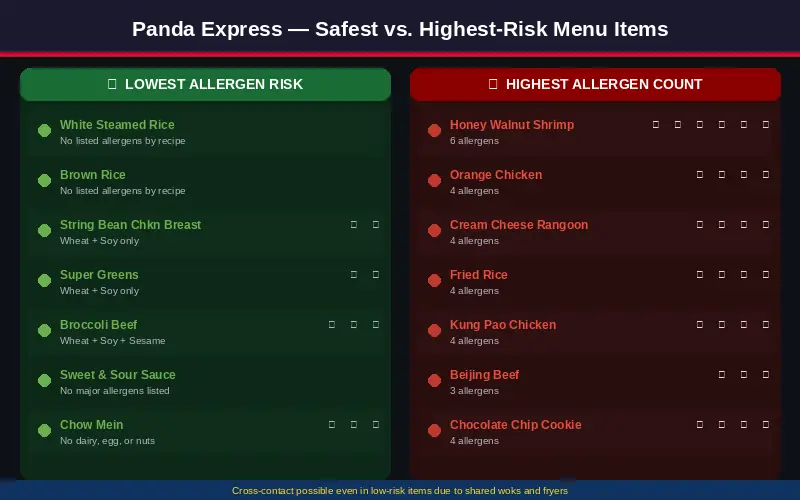
1. Wheat / Gluten Allergy
- White Steamed Rice — no wheat in recipe; cross-contact risk remains
- Brown Rice — no wheat in recipe; cross-contact risk remains
- Plain fountain beverages
Avoid: All noodle-based sides, all sauced entrees, all breaded items, all appetizers.
2. Soy Allergy
- White Steamed Rice — no intentional soy; cooked separately from wok items
- Brown Rice
- Plain fountain beverages
Avoid: Every wok-fired entree (all are cooked in soybean oil and soy-based sauces).
3. Peanut Allergy
Any dish that does NOT list peanuts is a lower recipe-risk choice — but cross-contact from Kung Pao Chicken in shared woks is unavoidable during service.
Most practical tip: call your location ahead and ask whether Kung Pao Chicken is active on the line that day. If not, cross-contact risk is meaningfully lower (though not zero).
4. Dairy / Milk Allergy
Better options: Chow Mein, Fried Rice (eggs present, no milk), Super Greens, Broccoli Beef, String Bean Chicken Breast, Kung Pao Chicken, most stir-fried chicken and beef dishes.
Avoid: Orange Chicken, Beijing Beef, Honey Walnut Shrimp, Crispy Shrimp, Cream Cheese Rangoon, Chow Fun, cookie desserts.
5. Egg Allergy
Better options: Chow Mein, White Steamed Rice, Broccoli Beef, String Bean Chicken Breast, Teriyaki Chicken, most unbreaded stir-fry entrees.
Avoid: Fried Rice, Orange Chicken, Honey Walnut Shrimp, Hot & Sour Soup, Cream Cheese Rangoon, baked dessert items.
6. Shellfish Allergy
Avoid all shrimp items entirely. For all other dishes, confirm with staff whether shrimp has been cooked in the wok that will prepare your order.
Better strategy: order at the opening of service before shrimp has been cooked in the shared woks that day.
7. Sesame Allergy
- White Steamed Rice ✓
- Brown Rice ✓
- String Bean Chicken Breast (lower sesame risk vs. other chicken items)
- Sweet & Sour Chicken Breast
- Sweet & Sour Sauce
Avoid: Chow Mein, Fried Rice, all teriyaki-glazed items, Kung Pao Chicken, Honey Sesame Chicken Breast, most sauced entrees.
How to Order Safely at Panda Express: What to Say to Staff
Many allergy guides tell you what to eat. Very few tell you how to communicate your allergy at the counter. Here is a practical 5-step approach.
- Step 1: Arrive during a slower service period. During peak lunch and dinner rushes, staff have less time for allergy conversations. If your allergy is severe, aim for mid-morning (after 10:30 AM, before 11:45 AM) or mid-afternoon — when the line is shorter and staff can give you their full attention.
- Step 2: Speak to the shift lead or manager, not just the cashier. Ask: “I have a [specific] allergy. Can I speak with the manager about what is safe for me to order?” Most locations will accommodate this. Managers have full access to the current allergen guide and know what has been cooked on the shared woks that day.
- Step 3: Ask about active hot bar items. If you have a peanut or shellfish allergy, ask: “Is Kung Pao Chicken / shrimp currently on the line today?” If yes, cross-contact risk across all other hot items is significantly higher.
- Step 4: Request fresh preparation for advance orders. For catering or advance phone orders, Panda Express can sometimes prepare items separately if given notice. This is not guaranteed for walk-in visits but is worth asking about for group orders.
- Step 5: Confirm your order matches what you discussed. Before accepting your tray, confirm the item names match your discussion with staff. Plain dishes (steamed rice, unbreaded stir-fry items) carry fewer allergen variables than sauced or battered items.
⚠️ Note: If your allergy is anaphylactic, carry your EpiPen regardless of the steps above. No fast-casual restaurant — including Panda Express — can guarantee complete allergen avoidance in a shared-kitchen environment.
8 Tips for Dining at Panda Express With Food Allergies
Check the allergen chart before you arrive, not at the counter. The official Panda Express allergen guide PDF is available at pandaexpress.com/nutritioninformation. Download it or bookmark it on your phone before your visit. Reviewing it at home gives you time to identify your options without pressure.
Use the Panda Express Nutrition Calculator on this site. The nutrition calculator lists per-item data so you can cross-reference macro decisions alongside your allergen needs — before you order.
Stick to plain items when in doubt. White Steamed Rice, Brown Rice, and plain Super Greens carry the fewest intentional allergens. The more sauce, breading, and wok-frying involved in a dish, the higher the allergen exposure.
Call your location ahead for catering or large group orders. For events, you can request that certain items be prepared in a less contaminated sequence or ask about sauce-free preparation. Catering staff are generally more accommodating for advance allergy requests than walk-in counter staff.
Do not rely on visual identification alone. Battered items look similar under the heat lamps after sitting through a service period. Always confirm item names verbally before accepting your plate — color and appearance alone are not reliable allergen indicators.
Treat sauces as a separate allergen decision. The soy sauce packets, teriyaki glaze, and chili sauce at the condiment station all contain wheat and/or soy. If you have chosen a lower-risk item, adding a high-allergen sauce undoes your effort. Sweet & Sour Sauce is the safest condiment option.
Re-check the menu whenever Panda Express launches a new or seasonal item. Panda Express regularly rotates limited-time entrees. These items may have different allergen profiles from the standard menu. The allergen PDF is updated when new items launch — check it again any time you see an unfamiliar item on the board.
Ask about cross-contact, not just intentional ingredients. The allergen chart covers intentional ingredients only. Ask staff: “Is this cooked in the same wok as Kung Pao Chicken / shrimp?” — not just “Does this contain peanuts?” The distinction matters for severe allergies.
Frequently Asked Questions
Does Panda Express have an allergen menu?
Yes. Panda Express publishes an official allergen guide covering all 9 FDA-recognized major allergens across every menu item. Access it at pandaexpress.com/nutritioninformation or ask for a printed copy in-store.
What are the allergens in Panda Express food?
Panda Express menu items may contain wheat, soy, milk, eggs, peanuts, tree nuts, fish, shellfish, and sesame — the 9 allergens required to be disclosed under FDA food labeling regulations.
Does Panda Express use peanut oil?
No. Panda Express uses 100% soybean oil for cooking — not peanut oil. However, Kung Pao Chicken contains intentional roasted peanuts, and cross-contact in shared woks is a risk for all other hot entrees.
Is Panda Express gluten-free?
No. Panda Express does not certify any menu item as gluten-free. Soy sauce — which contains wheat — is used in nearly every savory dish. White Steamed Rice and Brown Rice have no listed wheat, but cross-contact risk remains in the shared kitchen.
What allergens are in Panda Express Orange Chicken?
Orange Chicken contains wheat, soy, eggs, and milk. It is a battered and deep-fried dish, making it one of the higher multi-allergen items on the menu.
What allergens are in Panda Express Fried Rice?
Panda Express Fried Rice contains wheat, soy, eggs, and sesame. Eggs are cooked directly into the dish alongside soy sauce and sesame oil.
What allergens are in Panda Express Chow Mein?
Chow Mein contains wheat, soy, and sesame. The noodles are wheat-based, tossed with soy sauce and sesame oil.
What allergens are in Panda Express Kung Pao Chicken?
Kung Pao Chicken contains wheat, soy, peanuts, and sesame. It is the only standard Panda Express entree with intentional peanut content.
Does Panda Express Honey Walnut Shrimp contain tree nuts?
Yes. Honey Walnut Shrimp contains walnuts (tree nuts), along with shellfish, wheat, soy, eggs, and milk — making it the highest allergen-count item on the menu at 6 allergens.
What is the safest item at Panda Express for someone with multiple food allergies?
White Steamed Rice and Brown Rice have no intentional allergens listed in the recipe and are the safest choices by ingredient. Cross-contact from the shared kitchen is still possible.
Does Panda Express have dairy-free options?
Yes, several items are dairy-free by recipe: Chow Mein, Fried Rice (contains eggs, no milk), Broccoli Beef, String Bean Chicken Breast, and most stir-fried chicken entrees (excluding Orange Chicken and Beijing Beef). Cross-contact is still possible.
Does Panda Express add MSG to its food?
No. Panda Express does not add MSG. However, some naturally occurring ingredients used in their recipes — such as soy sauce — contain naturally occurring glutamate compounds.
Is sesame an allergen at Panda Express?
Yes. Sesame became the 9th FDA-required major allergen in January 2023. Panda Express discloses sesame across many menu items including Honey Sesame Chicken Breast, Chow Mein, Fried Rice, and all teriyaki-glazed dishes.
Can I trust Panda Express for a severe (anaphylactic) food allergy?
The shared-kitchen model at Panda Express — shared woks, shared fryers, shared utensils — makes complete allergen avoidance impossible for anaphylactic-level allergies. Panda Restaurant Group acknowledges this directly on its FAQ page at pandarg.com/frequently-asked-questions. Always consult your allergist before making any dining decisions.
Closing Thoughts
Panda Express is transparent about its allergen data — the official allergen guide is one of the more detailed ones available from a major fast-casual chain. But transparency about intentional ingredients is not the same as safety for severe allergies. The shared wok model means cross-contact is built into how every dish is prepared.
If you have a mild food sensitivity, this guide gives you a clear map of what to choose and what to avoid. If you have a severe allergy — especially to peanuts, shellfish, or wheat — have a direct conversation with the manager at your location before ordering, and keep your emergency medication with you regardless.
For calorie counts, macro tracking, and nutrition data alongside your allergen decisions, use the Panda Express Nutrition Calculator on this site to plan your full meal before you arrive.